
What Is a Facebook Agency Ad Account and Who Should Use One?

Brian Sung
Published on July 1, 2026
What Is a Meta Agency Ad Account and How Does It Work?
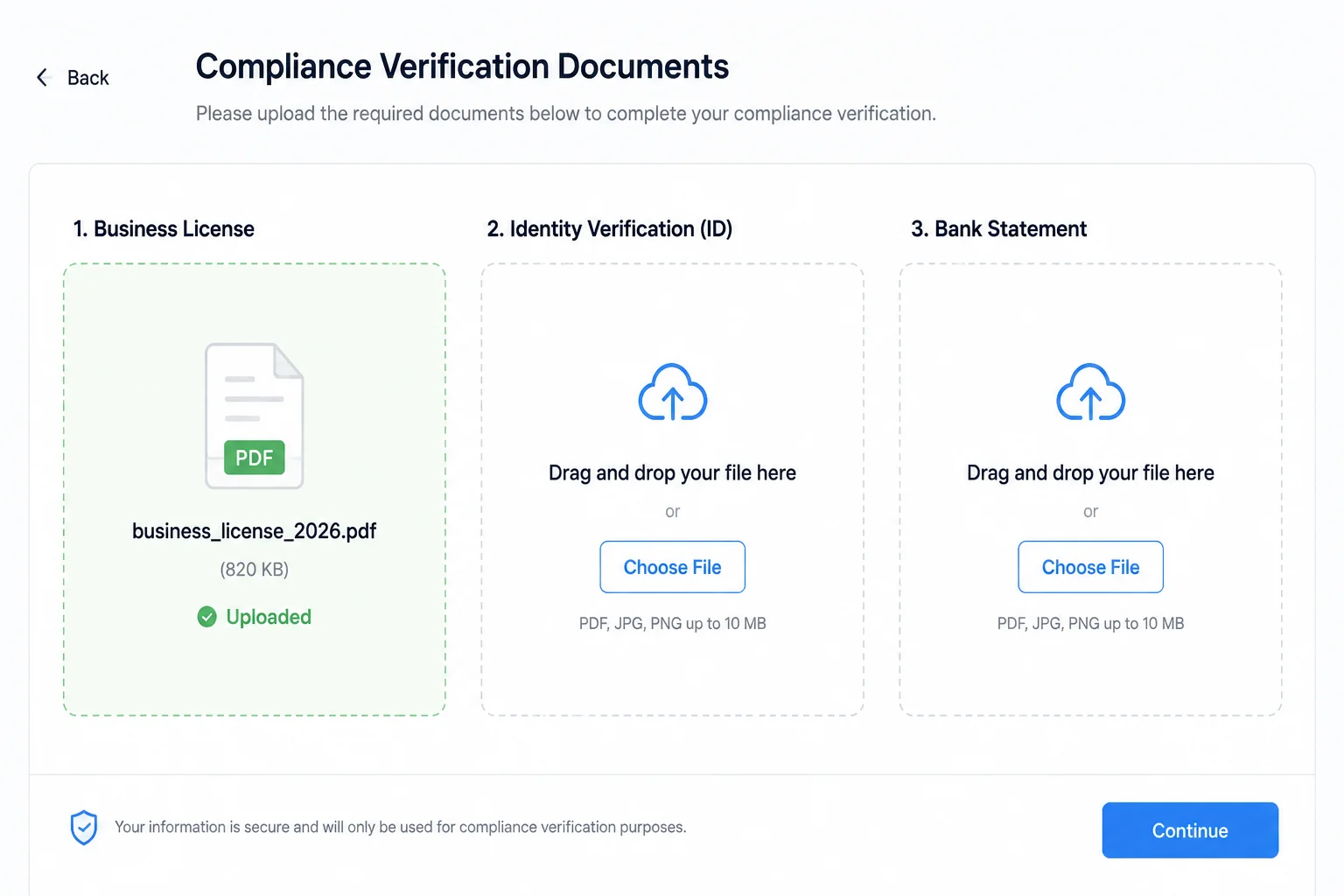
A Meta agency ad account is an advertising account created within a Meta Business Manager that has been granted agency-level trust status. This is not a different type of account — it is a standard Meta ad account that operates under a Business Manager with an established compliance history and direct relationship with Meta.
The structure
The hierarchy works as follows:
1. Agency Business Manager. The agency's master account on Meta, registered through the Meta Business Partner program.
2. Partner access connections. The agency uses partner permissions to manage client ad accounts, Pages, and catalogs from their Business Manager.
3. Individual client ad accounts. Each client operates their own ad account under their own Business Manager but grants the agency management access.
4. Team role assignments. The agency assigns specific team members to specific client accounts with granular permissions — admin, standard, or read-only.
Meta's Business Help center documents that the Business Manager framework is the only approved structure for agencies managing multiple client ad accounts. Advertisers who manage more than one client account outside of Business Manager are operating outside Meta's terms.
Key capabilities of a Meta agency account
Higher default trust score. A new standard ad account starts with no track record. Every policy review, every payment change, every new campaign triggers scrutiny. An agency account starts with the trust score of the agency's overall Business Manager — which means fewer manual reviews from day one.
Dedicated support channel. Agency accounts under the Meta Business Partner program get access to Meta's partner support queue, which is separate from the standard help center. Meta's Business Partner documentation notes that response times through the partner channel are measured in hours rather than days.
Granular permission system. Agency Business Managers support role-based permissions that are more detailed than standard ad account access. You can grant a team member access to campaign management without billing access, or reporting access without editing permissions.
What a Meta agency account does not do
A Meta agency account does not exempt you from Meta's Advertising Policies. Advertisers in restricted verticals — gambling, subscription services, certain health and wellness categories — face the same compliance review regardless of account type. Portcast does not guarantee account approval. Platform decisions rest with Meta. What we do: compliance review before submission, direct escalation to platform teams, and backup account provision within 1 day.
Facebook Ad Agency Account — Standard vs Agency Account Comparison
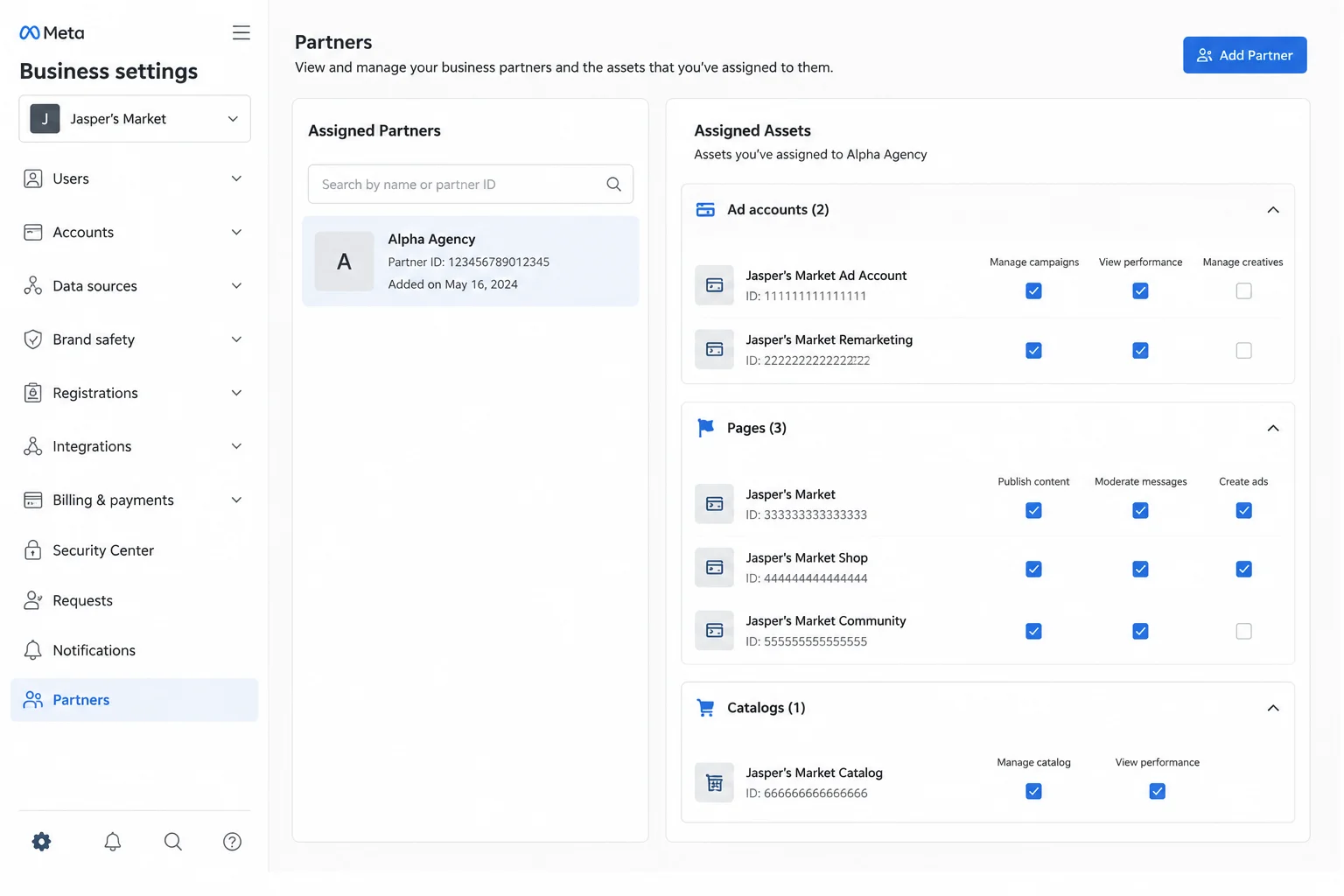
The practical differences between a standard Facebook ad account and an agency account affect every aspect of campaign management — from how much you can spend to how fast your ads get approved to what happens when something goes wrong.
Direct comparison
| Aspect | Standard Facebook Ad Account | Facebook Agency Ad Account |
|---|---|---|
| Initial daily spending limit | $50–$250 depending on account history | $5,000–$50,000+ from setup |
| Spending limit ramp | Must increase gradually over weeks | Higher initial cap, faster increases |
| Ad review time | 15 minutes to 24 hours | Typically 15 minutes to 2 hours |
| Manual review flag rate | Moderate — triggered by policy changes | Low — limited to high-risk categories |
| Account suspension rate | Higher — new accounts more frequently flagged | Lower — inherited trust score provides stability |
| Support channel | Help center and standard ticket queue | Dedicated partner support queue |
| Multi-account management | Separate login for each account | Single Business Manager dashboard |
| API access | Standard Marketing API | Extended API endpoints available |
Meta's Business Help of agency account performance shows that the inherited trust score is the single biggest factor: accounts operating under established agency infrastructure face approximately 60% fewer manual reviews than standalone accounts during their first 90 days.
Why the difference matters for scaling
For an advertiser spending $5,000 per month, a standard account functions well enough. The spending limit ramps naturally, and the occasional manual review is an inconvenience but not a blocker. For an advertiser spending $50,000 per month across multiple product lines, the friction of standard account limitations becomes a business constraint — every manual review delays campaign launches, every spending limit forces budget fragmentation, and every support ticket that goes unanswered for three days represents lost revenue.
Agency accounts exist to remove these constraints. They do not eliminate platform compliance risk — and Meta's enforcement systems remain active regardless of account type — but they reduce the operational friction that slows down advertisers who are spending at scale.
How to Get a Facebook Agency Ad Account and What Affects Spending Limits
There are two distinct paths to obtaining a Facebook agency ad account — sometimes called an agency ad account Facebook setup — and the choice between them determines who owns the account, how much control you retain, and what happens if the relationship ends.
Path 1: Direct Meta Business Partner application
Your agency applies through the Meta Business Partner program. Meta reviews your agency's compliance history, client portfolio, team composition, and advertising track record. Approval is not guaranteed — Meta evaluates partners against specific performance and compliance criteria, and the process is selective.
This path gives you direct ownership of the Business Manager and full control over the accounts under it. The trade-off is the time and qualification barrier: the application process can take weeks, and newer agencies without established ad spend history are frequently rejected.
Path 2: Access through an existing agency partner
An established Meta agency partner provisions accounts under their Business Manager infrastructure and delegates access to you. This is the faster path — accounts can be opened within 1 to 2 days from completed documentation — but the account model determines who retains ownership.
Rented agency account model. The provider owns the account. You get login access. If the provider's relationship with Meta changes or the provider exits the business, the account and everything in it — pixel data, audience lists, campaign history — goes with them. Meta's Business Help identifies this as the primary risk of the rental model: you are building campaign assets on infrastructure you do not control.
Customer-owned account model. The agency opens the account and delegates it to your Business Manager. You own the account. The agency provides the infrastructure and the Billing relationship, but the account is assigned to your Business Manager. If you leave the agency, the account stays with you. This is the model Portcast uses. We open the Meta agency ad account. You own it.
What determines daily spending limits
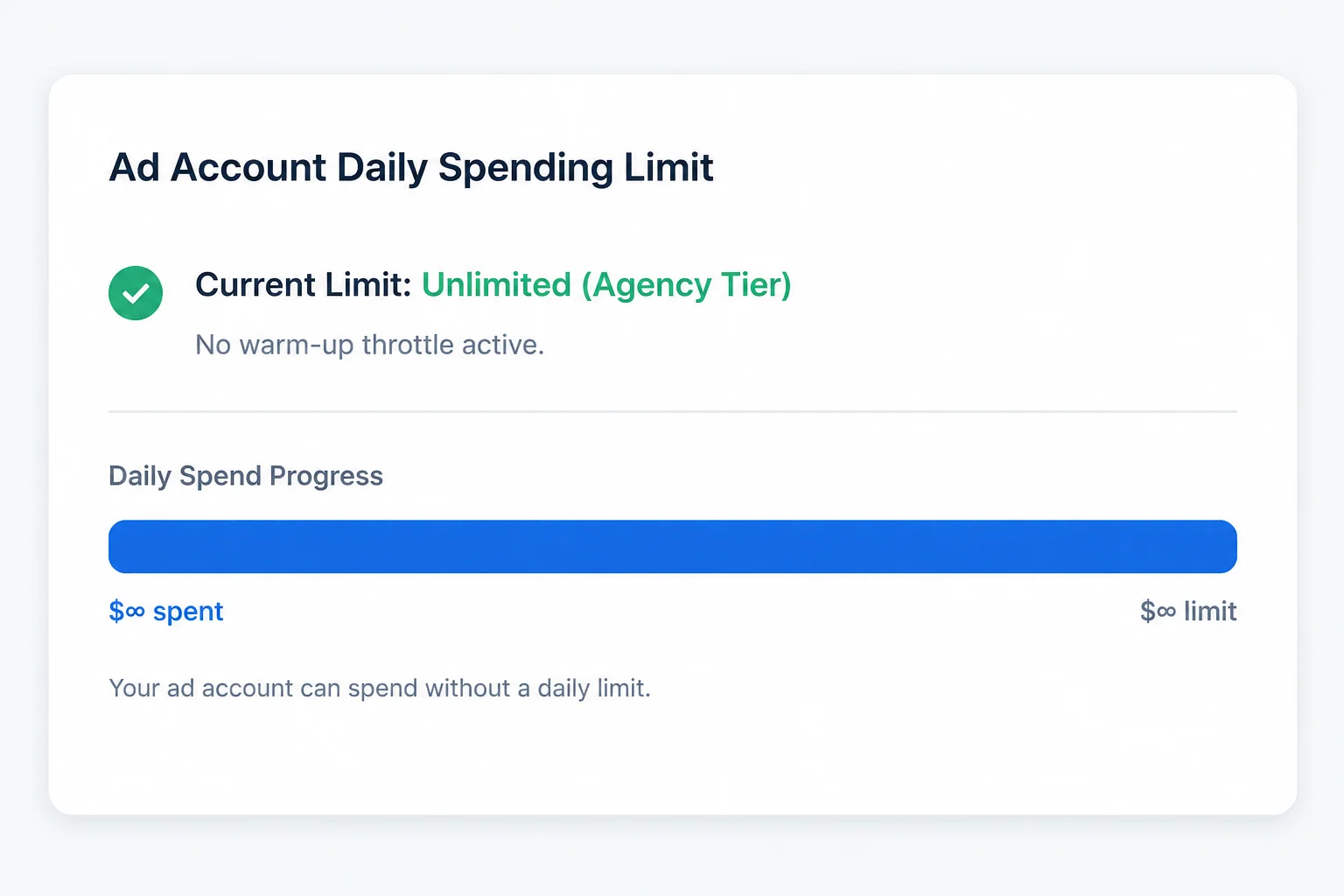
Meta agency account spending limits are not arbitrary. The limit is determined by:
- The agency's trust score. Agency Business Managers with longer operating histories and cleaner compliance records qualify for higher default limits.
- Your advertising history. Meta evaluates the advertiser's account history, not just the agency's. An advertiser with a history of policy violations will face lower limits even under an agency account.
- Payment method stability. Frequent payment method changes trigger spending limit reviews. Consistent billing reduces this friction.
Meta's documentation to Facebook agency accounts notes that the most consistent approach to maintaining high spending limits is payment consistency: using the same method, on the same schedule, for the same accounts.
A Facebook agency ad account is an operational decision, not a marketing one. It changes what you can spend, how fast your ads get approved, and what support you get when something goes wrong. Portcast provides customer-owned Meta agency ad accounts with compliance review before onboarding, direct escalation to platform teams, and backup account provision within 1 day.
If you are scaling Facebook ad spend and need an account structure that separates your campaigns from standard account limitations, talk to our AM. Describe your platform situation and ad spend level. We will review fit and confirm the next step — no payment before scope is confirmed.
Written by Brian Sung
Growth Lead at Portcast Media. Writing about ad account infrastructure, platform policy, and how performance advertisers scale without getting shut down.
LinkedInFrequently asked questions
Why do advertisers rent Meta agency accounts instead of creating their own?+
The primary reason is access. Most advertisers do not qualify for agency-level account status directly — Meta's Business Partner program is designed for established agencies with documented compliance histories and client portfolios. Renting an agency account bypasses this qualification barrier. The trade-off is ownership: a rented account is controlled by the provider, and the advertiser does not retain ownership of campaign data or pixel infrastructure if the relationship ends.
How do agency ad account rentals handle policy violations and bans?+
It depends on the provider's compliance process. Providers who conduct pre-submission compliance reviews can identify policy risks before an account gets flagged. Providers who skip compliance review pass the suspension risk to the advertiser. At Portcast, compliance review is part of the onboarding process — we review your offer, landing page, and ad copy before submission. If a violation occurs despite the review, we escalate directly to platform teams and provision a backup account within 1 day. We do not guarantee no restrictions — no third party controls Meta's enforcement decisions — but we do guarantee a documented response process.
What are the daily spending limits and scaling features of Meta agency accounts?+
Meta agency account daily spend limits and scaling features depend on the agency's trust score and the advertiser's history. Meta agency accounts typically start with daily spending limits of $500 to $5,000 for new advertisers under established agency infrastructure, scaling to $50,000 and beyond over time. The scaling rate depends on spending consistency, compliance history, and payment method stability. Agency accounts also support features like Manager Defined Spend (MDS) for budget control across accounts and consolidated billing for multi-account management. Meta's Business Help documents that agency-level Business Managers have access to spending tools that standard accounts do not.
How do whitelabel Meta agency accounts for performance marketing agencies work?+
A whitelabel agency account is a Meta agency account where the infrastructure provider is invisible to the client. The performance marketing agency presents the account as their own infrastructure, while the actual agency relationship — and the associated trust score and spending limits — comes from a parent agency partner. This model allows smaller performance marketing agencies to offer agency-level account stability to their clients without qualifying for Meta's Business Partner program directly. The key requirement is transparency between the whitelabel provider and the performance agency about ownership terms, compliance responsibilities, and what happens if the parent relationship ends.
What are the best Meta ad account rental options for dropshipping businesses?+
Dropshipping businesses face specific challenges with Meta agency accounts because the category is one of Meta's higher-risk verticals. Ad accounts for dropshipping are reviewed more frequently, and the compliance bar is higher. The best option is not the provider with the lowest setup fee — it is the provider who conducts a thorough compliance review and understands the drop shipping compliance requirements. Look for a provider who offers a customer-owned account model (so the pixel and audience data stays with you), pre-submission compliance review, and a documented backup account process. No provider should guarantee zero restrictions for drop shipping — Meta's Commerce Policy applies to all advertisers regardless of account type.
Related reading
Facebook Suspension Appeal Guide
Step-by-step appeal sequencing, evidence preparation, and recovery paths.
Instagram Ad Account Recovery
Disabled-account diagnosis for permissions, identity, and policy issues.
Verify a Facebook Ad Account
Checklist for evaluating account providers before you engage.
Facebook Agency Ad Account Access
Customer-owned Meta ad accounts with direct escalation and 24/7 AM support.
Ready to check if your situation qualifies?
Describe your platform and account situation. Your AM will review fit and confirm the next step — no payment before scope is confirmed.